
what startups and small businesses can learn from each other…
*This article is based on a presentation given at DC Startup Week 2022
What gets an investor excited about a startup? Will that same pitch work for a small business?
Let’s talk about how both startups and small businesses can strengthen their performance to attract capital from outside investors, or just get on a firmer path for self-funding. Regardless of what type of enterprise you run, it’s important to consider how you can de-risk your business and drive up interest in your organization by demonstrating you understand how your business operates, how to make money reliably, and how to manage money responsibly.
Before we get to the lessons, let’s highlight some general differences between startups and small businesses.
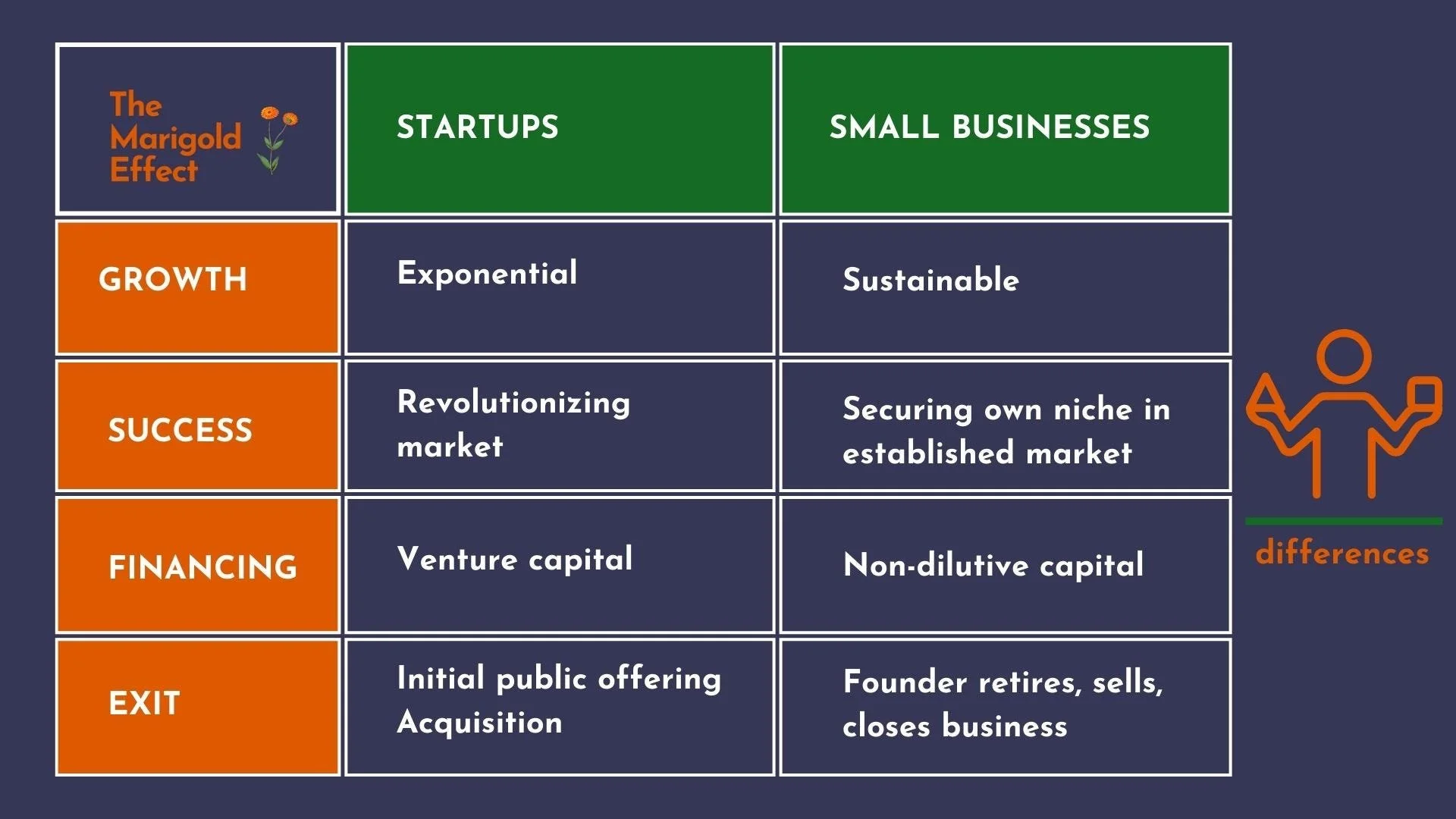
Startups seek exponential growth while small businesses desire sustainable and consistent returns.
Success for once-startup Uber was its technology revolutionizing how we hail taxis while a small business becoming the go-to ice cream shop in the region is a success.
When it comes to funding, startups often look to outside investors, such as angel investors or venture capital firms to come in before they are established via equity investments that translate to shared ownership. Small businesses are more commonly self-funded or receive non-dilutive capital in the form of debt instruments such as traditional loans, revenue-based financing, or equipment financing.
And from the beginning, many startup founders contemplate what an exit might look like. Is it an initial public offering (IPO) or being acquired for an attractive price? In a small business, exits often are referred to as “succession planning.” In reality, they might not be planned at all and only truly contemplated by an entrepreneur as they approach retirement or face a financial or health crisis.
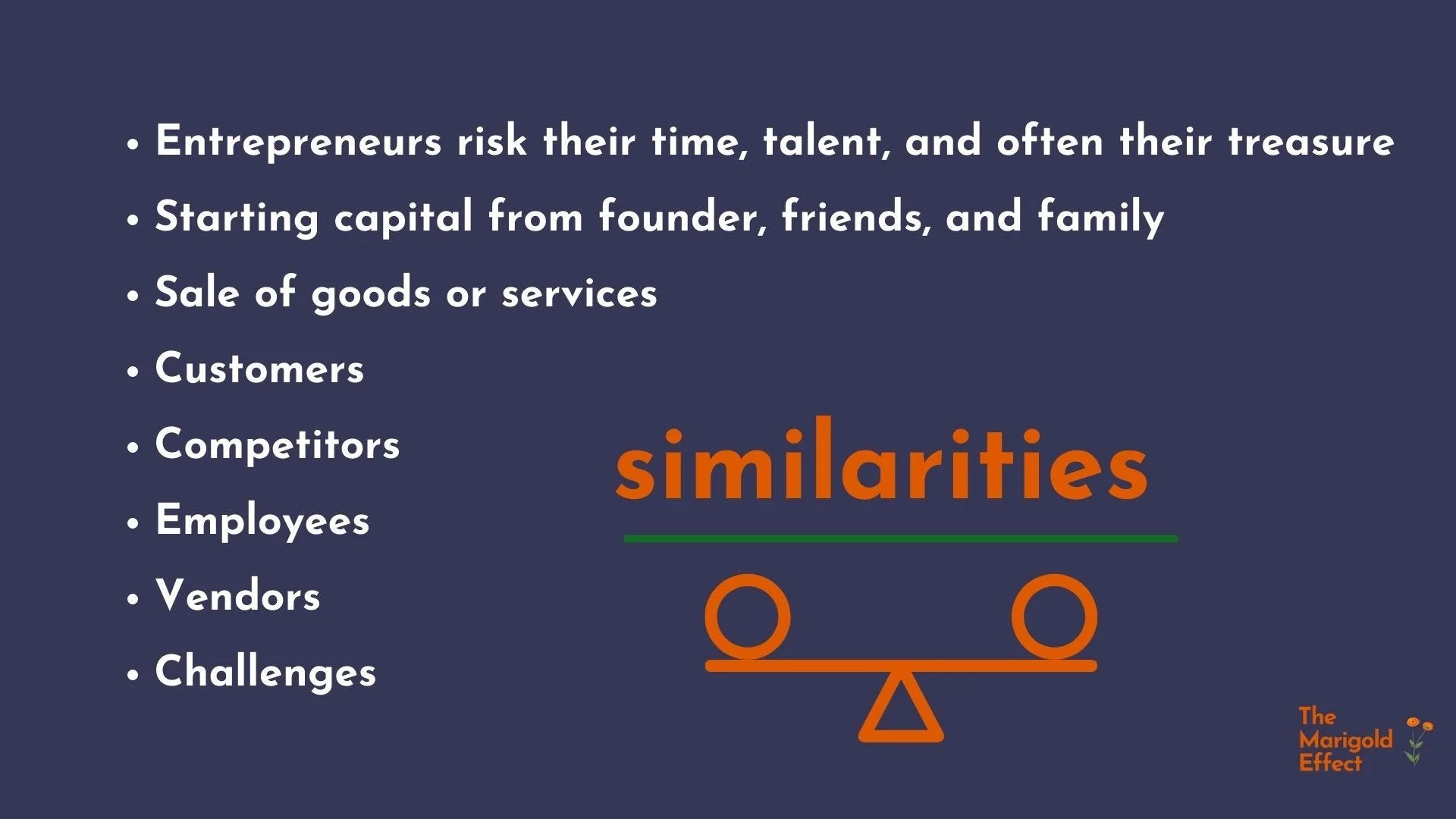
While startups and small businesses differ in significant areas regarding growth, funding, and the definition of success - they also have a lot in common. They are both started by entrepreneurs who risk their time, talent, and often their own treasure and neither is without competitors or challenges.
I believe startups and small businesses can learn a lot from each other about how to improve their own performance and set themselves on the path to profitability and better odds of attracting outside investors, if desired.
Here are 5 lessons with some examples, drawing on my own experience.
Lesson #1 - Understand your company inside and out
When my brother and I opened our first restaurant together, I was very focused on the “Front of House” - meaning bartenders, servers, and hosts. I didn’t pay as much attention to the “Back of House” - home of our pizza cooks, dishwashers, and prep - mostly because I wasn’t as comfortable in that environment.
We began to have performance issues related to the kitchen - longer cook times and increasing food costs. It was stressful. When I raised these concerns with my kitchen manager, he always seemed to think the causes were the “Front of the House.”
While I disagreed, the truth was I didn’t know enough about his job, or the employees he supervised, to lead the kitchen with confidence. So I spent two weeks learning every single job in the back of the house, from prep to dishwashing. I never became close to perfect in any of them, but my hands-on experience allowed me to see my kitchen manager's frustrations and help him think about solving the problems, rather than blaming other departments.
This lesson isn’t just for brick-and-mortar small businesses. A startup founder who understands all the pieces of their business is in a stronger position to lead, and others will notice. If you’re a non-technical founder, for example, you should understand the technical side of your business enough to communicate with your development team about the desired outcomes and associated timelines. If you understand customer acquisition, you can hire the right salespeople.
Understand your company inside and out.
Lesson #2 - Don’t run out of cash
I had a client who owned a landscaping business. Their top-line recurring revenue was great. Unfortunately, most of it came from a few big contracts. Well, one of their biggest clients suddenly went out of business and they lost 20% of their revenue. Overnight.
They had never spent the time to see what their burn rate was (the monthly amount of cash the company was spending). Their cash runway (the amount of time the company had before it ran out of money) was less than 4 months. They were pretty close to running out of cash by the time we started working together.
They needed to acquire new customers, and fast, but they barely had enough cash to maintain operations, much less ramp up a marketing effort. From an investor perspective, would you invest in this business to help put gas in the lawnmowers? Or would you be more excited by an opportunity where the business was in a place to use capital to expand its operations and purchase new machinery?
How can you plan ahead to avoid cash flow problems whether you’re a startup or a small business? Here are some ideas…
Know your monthly burn rate and your cash runway. Keeping track of these two numbers will also help you see how much revenue you need to make to keep going.
Forecast with room for error and update your projections regularly. Things happen. Market downturns. Venture capital dries up for a period. Failed product launches. Pandemics. Losing a major account.
Apply for a line of credit before you need it.
Collect your money. Contact your customers about unpaid invoices, shorten the time for when you collect accounts receivable, offer discounts for early payment, and consider pre-selling your products or services.
Minimize excessive inventory,
Negotiate better terms for when you pay your vendors
If you can better manage your cash flow, you don’t have to be that founder with their back up against the wall over making payroll or paying suppliers.
Lesson #3 - Spend wisely to maximize returns
In Hindi, there’s a word “kanjoos” - it loosely translates to stingy, which is kind of negative. Someone might think you’re not being a good host if you’re kanjoos with the wine and cheese. But if you’re a small business or a startup, it can pay to be strategically stingy.
One way to do that is to analyze your expenses for opportunities to reduce costs.
Consider bartering. In our business, we wanted to recognize our employees with an off-site holiday party, but we didn’t want to rack up a big bill to do it. So we traded spaces with another restaurant in the neighborhood. They hosted our parties, and we hosted theirs.
What is something you need that you could trade for instead of pay for?
Another tip: Negotiate expenses yearly. I don’t sign long-term contracts unless it comes with a major discount. I review my biggest expenses constantly. I look for competitor pricing to see if it is possible to beat what I’m currently spending.
In addition to cutting costs, focus on selling the goods and services with the highest profits or margins (startup talk for this is often “unit economics”). In a restaurant, the gross profit of a large pizza would be the sales price minus the “cost of goods sold” - which is the ingredients. At our pizza restaurant, the best unit economics came from plain cheese pizza and coke from the soda gun. It’s one of the many reasons I loved our family regulars. I will take the toddler palate to the bank every day.
For a software as a service (SaaS) startup, maybe you only sell one product. So instead of trying to sell more of your highest-profit products, you might be trying to acquire your highest-profit customers. You’d do that by looking at the cost to acquire a particular type of customer compared to the lifetime value of that customer. Maybe your version of the cheese pizza and a coke is the all-night gamer, or it could be a federal government agency. You don’t want to spend your resources chasing customers who are too expensive to serve.
So, be kanjoos. Spend wisely.
Lesson #4 - Bring your passion and carve your position in the market
Startups tend to see a problem, analyze the market, and position themselves where they see an opportunity. In contrast, I have met many small business owners who start a business for the sole reason that it’s something they’re passionate about. A love for knitting that results in an Etsy store, or a love of food that leads to the creation of a consumer packaged good.
Passion is a huge asset. People work harder and smarter when they really care about what they are doing. And sometimes a passion project becomes a profitable business. But what if no one wants what you’re selling, or the market is already saturated and there’s no clear way for you to stand out?
The secret is to match up genuine passion with savvy market positioning. Small businesses can learn from startups how to set their products and services apart by ensuring they’re meeting a real need in the marketplace, and startup founders can learn from small business owners how to infuse the company with the drive and commitment that comes from loving what you do.
Lesson #5 - Create incentives for your employees to act like a founder
Most startups understand incentives and commonly use equity compensation to get talent to stay longer and when they aren’t able to offer lucrative salaries. Some have commission structures that tie to what the company cares about, such as user engagement or customer retention. Some create opportunities for an employee to exercise some freedom or control over a particular project.
On the other hand, a lot of small businesses think about paychecks and required benefits.
In our recently sold family business, I saw my parents share in the upside. They structured financial incentives to encourage employees to help the business succeed. They offered payroll advances, profit sharing, bonuses based on performance metrics that impacted our bottom line, earned equity as a path to ownership for long-time managers, and on two occasions, became the private mortgage lender to employees who got credit-scored out of traditional banking.
Small businesses could benefit from introducing incentives to get their employees to think more like founders.
So those five lessons again:
Understand your company inside and out
Don’t run out of cash
Spend wisely to maximize your returns
Bring your passion and carve your position in the market
Create incentives for your employees to act like a founder
Executing on these things can put you in a stronger financial position, whether you’re trying to self-fund your business or raise outside capital.
-Pooja Mehta
