
the old arguments against a stronger social safety net don't add up
Updated April 16, 2020, with latest death and unemployment tallies.
The coronavirus pandemic which has caused close to 140,000 deaths across the globe and brought the U.S. economy to a screeching halt seems to be bringing out the best in us.
Will we keep up this all-hands-on-deck spirit after we’ve defeated the virus? I hope so.
If anything good comes from this crisis, it should be a firm national commitment to a permanently strong social safety net for all Americans. And business should lead the way.
In his 1963 letter from Birmingham City Jail, Dr. King defended the civil rights work that got him arrested as an “outside agitator” —
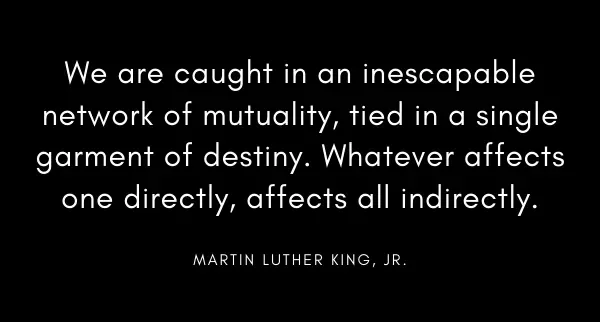
Though King was from Atlanta, he felt called to join Black folks in Alabama in their struggle for racial and economic justice. He challenged White clergy to do the same. That spirit of solidarity, rooted in his recognition of our interdependence, animated King’s civil rights leadership.
In this time of social distancing, our interdependence is more apparent than ever.
Our droplet-spreading coughs have rocketed the U.S. to the top of the list of countries with the most COVID-19 cases in the world. While some of us may be more vulnerable, we’re all at risk. We’re told to stay at home to prevent the spread and give hospitals time to catch up to the virus. Schools: closed. Businesses: closed. Gatherings: prohibited.
Right now, solidarity means sacrifice. While we are scared, we also should be inspired by what’s actually essential.
Doctors, nurses, and front-line medical staff risk their lives and separate from their families to care for the sick and keep the virus from spreading. And sometimes they sing songs for us.
Grocery clerks, delivery drivers, and food bank volunteers make it possible for people to stock up and #stayhome.
Sanitation workers keep waste from piling up where disease-carrying critters could take refuge.
Restaurant owners like my dad — he started as a Burger King assistant manager 39 years ago and now is a franchisee — close their dinings rooms but provide delivery, drive-through, or curbside meals to essential workers and to families.
And all of us find new ways to connect and support each other during adversity — playing games via video conference and taking walks together on opposite sides of the street.
Despite all this, the consequences of the novel coronavirus are devastating. And the worst is not yet behind us. So far, more than 28,000 people in the United States have died from COVID-19. More than 22 million people have registered for unemployment benefits. Seventy-five million students have had their school year interrupted as schools, colleges, and parents scramble to keep learning going under impossible circumstances.
The federal government has responded with a $2 trillion fiscal stimulus, the largest in our history. It includes funding to fight the virus and also cash support for most households, expanded unemployment protections for those already in the system and for gig and contract workers who aren’t typically covered, paid sick and family leave, and funding for small and medium businesses to maintain payrolls. The CARES Act passed unanimously in the Senate — a big deal in these partisan times — and was swiftly passed by the House and signed by the president. A massive act of solidarity from our elected officials.
While we aren’t through the crisis, it’s not too soon to plan for what comes next. We all will be changed by this unprecedented public health pandemic, physical lock-down, and economic stoppage. The question is how will we react once we’re through it. Will we go back to business as usual, or take lessons from the crisis to remake our system for the better? I hope we will emerge with a shared belief that we are indeed “caught in an inescapable network of mutuality” that demands solidarity — not just in times of crisis, but always. I hope we will emerge with a shared commitment to stitching together a permanently strong social safety net for all Americans. Business leaders can and should lead the way and help sew the threads.
What we are all seeing more clearly than ever is that businesses depend on people. When customers and employees struggle, businesses struggle. It’s in companies’ self interest to keep people from falling through the cracks. I’ve seen this first hand as a lawyer for families in the foster care system, as a business owner, and most recently as an advisor to a workforce development nonprofit.
Family members can’t get to their jobs ready for work when they don’t have reliable housing or transportation. That means their employers have to cover their shifts or hire new workers, which costs time and money.
When people don’t have decent health coverage or paid sick leave, they come to work sick. That threatens workplace health and safety. We are seeing the worst-case scenario right now, but this is an ongoing risk even without a pandemic.
Without universal access to education and training beyond high school, companies are forced to delay projects and absorb training costs as they prepare employees for success. While workforce-development organizations are trying to fill the gap in partnership with colleges, non-profits, and employers, there are scant resources available to upskill workers.
Parents who don’t have access to high quality childcare face an impossible choice: stay home to care for their kids and forego income from paid work, or go to work worrying the whole time whether their children will be okay when they get home. Companies either miss out on talent when parents stay out of the workforce or manage employees experiencing extreme stress.
The old arguments against a stronger social safety net just don’t hold up.
We can’t afford it? Congress just found $2 trillion under the couch cushions and more spending is on the way. But this isn’t just about growing the debt. Up-front social investments will pay long-term economic dividends to the private and public sectors alike.
People will abuse it? The lowest paid workers — drivers, grocery clerks, front-line medical staff — are proving how critical they are by keeping the rest of the country safe and supplied. They deserve these protections and supports.
Productivity will decline? A stronger social safety net means a larger, better-prepared, and more flexible workforce. These things all boost productivity, not slow it.
We will get through this pandemic. There will be a new normal on the other side. The question is whether we’ll shore up our economic system in the same spirit of solidarity that animated Dr. King’s work 60 years ago and that animates our collective response to the coronavirus crisis today. I hope the answer will be yes. And I hope business leaders will lead the way.
-Pooja Mehta & Phillip Martin