
$50 and a library book
Choosing to stay
By late summer 2025, Washington, DC - the city I had called home for more than 20 years - had become almost unrecognizable to me.
The Trump administration had called up the National Guard in response to a made-up “crime emergency,” unleashed masked immigration agents to harass and snatch up our neighbors, and painted over Black Lives Matter plaza while announcing Confederate statues would be reinstalled.
For-sale signs popped up on every block as thousands of DC residents got “DOGEd” out of their jobs and pushed out of the city.
Many who weren’t being forced to leave the District still wondered if they should go somewhere else, if they could. Somewhere safer and saner, whether in the U.S. or abroad.
I admit the thought of leaving crossed my mind, too.
I even asked my husband – whose family came to the U.S. in the late 1800s from Germany, Ireland, Italy, and Norway – whether we could somehow get European citizenship. (We can’t.)
But then I picked up a copy of This Is Where You Belong, by Melody Warnick, from my local library, and my mindset shifted. The core message of the book is that if you want to love where you live, then you should act like someone who does. Loving one’s community includes getting politically involved – especially in response to extreme and unjust threats to our freedoms – but that’s not all.
The book offers ten modest ideas for building attachment to where you live: walk more, buy local, get to know your neighbors, do fun stuff, explore nature, volunteer, eat local, be more political, create something new, and stay loyal through hard times.
These were hard times, and I wanted to try loyalty on for size.
Warnick borrows from the demographer Richard Florida’s book, Who’s Your City?, which describes three kinds of people: the mobile, who have the resources and freedom to move; the stuck, who may want to leave but can’t; and the rooted, who have the means to go and choose to stay because they have found something worth staying for.
I wanted to be the third kind of person. Someone who could leave, but chooses to stay. I wanted to plant our roots deeper, not yank them out and have to replant them somewhere else. Warnick relays this wisdom from Simone Weil, which resonated with me: “To be rooted,” she said, “is perhaps the most important and least recognized need of the human soul.”
The more I thought about it, the more I understood that falling in love with DC again – and helping to make it a place that others love and can stay in, too – was not just going to happen on its own. It was something I was going to have to make happen. It’s like bell hooks’s idea of “love as an action.” It’s something you do.
So when an unusual opportunity to deepen community came across my desk, I paid attention.
Sam Pressler, who writes the Connective Tissue newsletter, asked his readers, “What’s one thing that any community could do right now to strengthen local civic life?” And he offered fifty dollars for people to gather with neighbors to “imagine possibilities for your shared place.”
I forwarded the email to my husband. He replied: “Shouldn’t we be the ones giving people money, not asking for it?”
He wasn’t wrong. We are lucky to have extra funds each year to make charitable and political donations part of our family budget. But I wasn’t just after the $50. I wanted permission, encouragement, a little accountability, and the chance to get connected to other people wanting to answer that question. So I applied.
Ten days later, the money arrived in my Venmo account and I was invited to a planning call with the other grantees. The encouragement was to make our community meetups accessible, casual, and welcoming. Not big and scary. I made a flier inviting people to meet in front of our house for Polaroids and coffee and we posted it around the neighborhood.
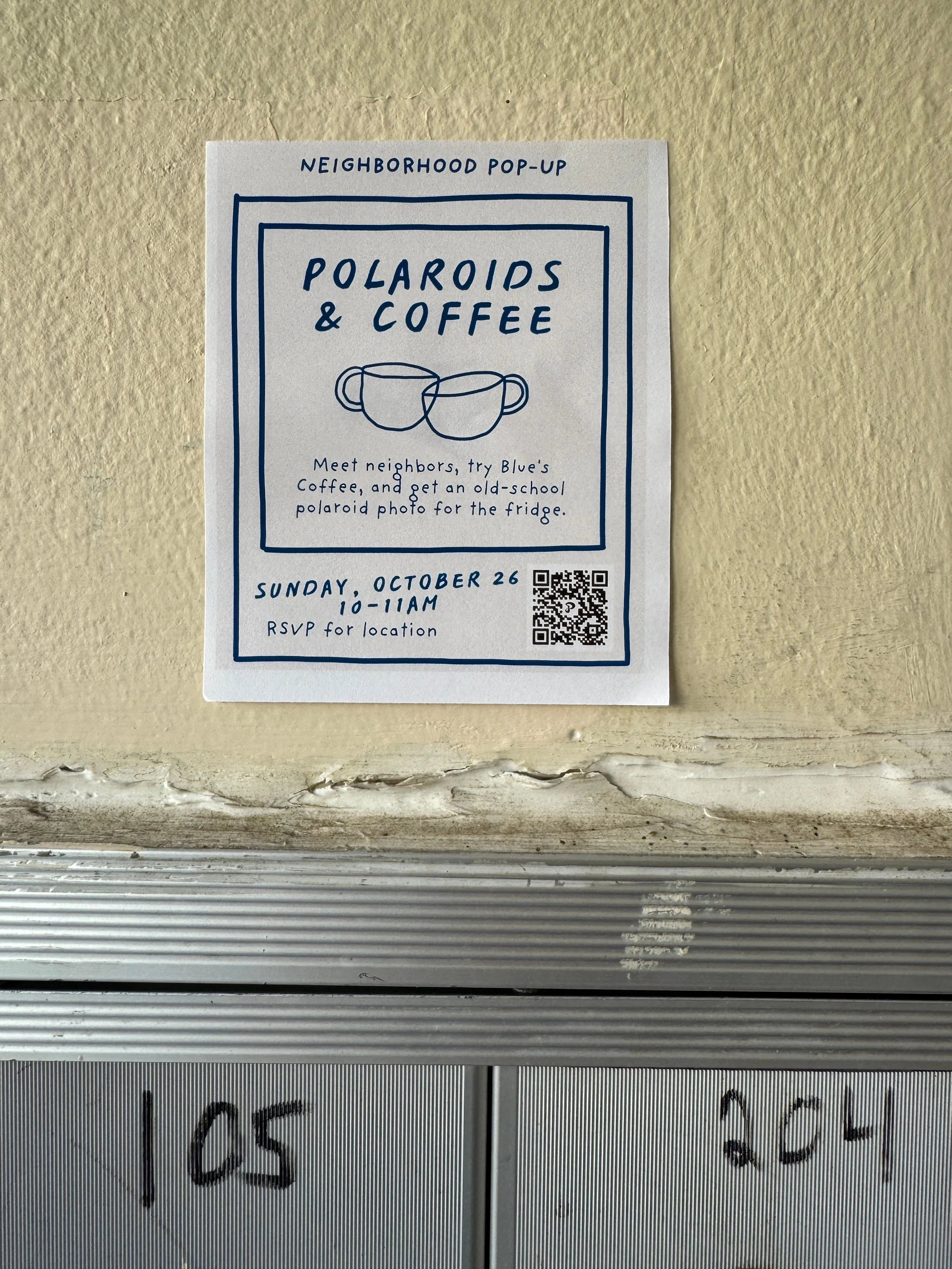
Polaroids and coffee
On a chilly Sunday morning last October, we set up a table on the sidewalk and waited for our experiment in community to unfold. My friend who founded Blue’s Coffee & Tea donated coffee, we purchased local apple cider from the Takoma Silver Spring Co-op, and with the help of our next-door neighbor we set up a makeshift photo backdrop on our little front lawn to make mini Polaroid pictures.
To our surprise, more than 30 people came – most of whom we had never met before. There was no agenda, no big call to action at the end, just a chance for people to meet and chat and share ideas for our neighborhood with post-it notes.
The first person to show up was a woman on her way to the grocery store. She hadn’t seen the flier but she decided to stay for some coffee and conversation. Already the permission to hold the event was paying off. She probably would’ve kept walking and I probably wouldn’t have bothered her to stop and talk if there wasn’t a table with hot drinks in front of our house. I remember thinking that if no one else comes, this one conversation would have been worth it.
But more people came.
A neighbor we had met on a walk a few years back brought tomatoes from her garden and introduced us to her daughter who later put us on two group chats (one for dog owners and one for parents).
We learned we have South Asian neighbors raising their kids just a few blocks away, which was comforting. My family is from India and we were in the process of adopting a child from there, so it was nice to share that cultural connection with such nearby neighbors.
Our advisory neighborhood commissioner (ANCs are hyperlocal elected officials in DC) came by after her morning workout and mentioned that she used to walk the block and talk to neighbors in person but had stopped after COVID. Maybe she would do it again. We talked about people who had moved to Portugal and imagined together what it would take for people to want to stay – or to come back.
One woman rushed over from another event because she had Googled me and thought I was the Pooja Mehta she had been hoping to meet. I was not. But she stayed anyway and introduced me to her daughters, whom she had adopted after being their foster parent for years. We talked for almost an hour about the different ways to grow a family.
Kids and grownups alike posed in front of our multicolor tapestry and went home with a throwback keepsake. We liked the idea of the photo being something physical. It went with the in-person meetup theme at a time when so much of our lives are lived online.
While we were overjoyed at the number of people who came and the genuine conversations we had with these neighbors, there were also people missing. None of our Spanish-speaking immigrant neighbors came. In a diverse neighborhood like ours, their absence was noticeable and it wasn’t for lack of outreach. It was a reminder that when the stakes are high – ICE was actively rounding people up – even walking down the block to chat with neighbors can feel - and be - unsafe.
Coming home
In December 2025, after several years of waiting, my husband and I got matched with a baby girl for adoption thousands of miles away in Rajasthan, India. She had been born in early October, a few weeks before our DC neighborhood meetup. We visited her in January and returned to India in April to take custody and finalize the adoption, which took nearly three months.
As the time went by in India, we started asking similar questions again. What do we want “family” and “community” to mean now that we are raising a child? What would make us want to stay in the Washington, DC, area to deepen our roots instead of transplanting ourselves somewhere else?
I returned to This Is Where You Belong. The ten ideas read less like thoughts for contemplation and more like an action plan. Become more political. Make something new. Do fun stuff. Stay loyal through hard times. So we decided to take action even before coming home. While still in India, we designed and launched a microgrant program of our own to support local visual storytellers documenting the solidarity economy in the Washington, DC, area. My firm - The Marigold Effect - has since awarded over 25 grants of $1,000 each to photographers, filmmakers, and other visual artists who will tell the story of local efforts – including food rescue operations, arts spaces, native plant nurseries, housing cooperatives – that put people and place ahead of profits. Our hope is that our neighbors who have the means to leave will choose to stay in DC and be part of these community-based efforts – or even start their own.
Now that we’re back home in DC, raising our child here, the should-we-stay or should-we-go question feels different. It’s not only about our safety and wellbeing and quality of life, it’s also about hers. We don’t know if staying will always be the right answer, but for now, for us, it absolutely is. Things are still hard – more so for many of our neighbors than for us. The federal takeover is still here. But while we have the means to go, we’re not going to let them chase our family away. And we’re going to do what we can to support and shine a spotlight on all the beautiful, people-powered things happening in this community in spite of the efforts to tear them down.
A little goes a long way
So what came from that $50 grant from a guy with a newsletter in North Carolina and a book I borrowed from the DC public library? So much. A renewed commitment to root and grow our family in this community. More smiles and hellos during walks in the neighborhood. Play dates, book clubs, and clothing swaps with people who share our values. And an effort to pay it forward through the Solidarity Stories Microgrants program. And who knows what may come next.
When things are really bad, like they are now across the U.S. – and especially here in DC – sometimes it doesn’t feel like we have the power to make a difference. And it’s true we’re not going to stop fascism or reverse wealth inequality with book clubs and sidewalk popups alone. But if we can all do something small to get to know more of our neighbors, shine a light on what’s great about our communities, or find ways to make things a little bit better, those small efforts can multiply into something a lot bigger. Into something worth staying for.
Not sure where to start? Get inspired here.
-Pooja Mehta